

What enterprise AI actually needs in 2026, and why the industry is only halfway there
You build the pipelines. The data lands in the warehouse, schemas are clean, and the semantic layer is live. You wire up the AI agent. It runs. Then someone in a quarterly review asks why the agent’s revenue number does not match finance’s, and you realize the problem was never the data. Nobody told the model what ‘revenue’ means to this business, which systems are authoritative, or which three representations of the same entity should resolve to one thing. That is the semantic gap.
And the numbers say most organizations have not closed it. Here are some of the latest statistics:
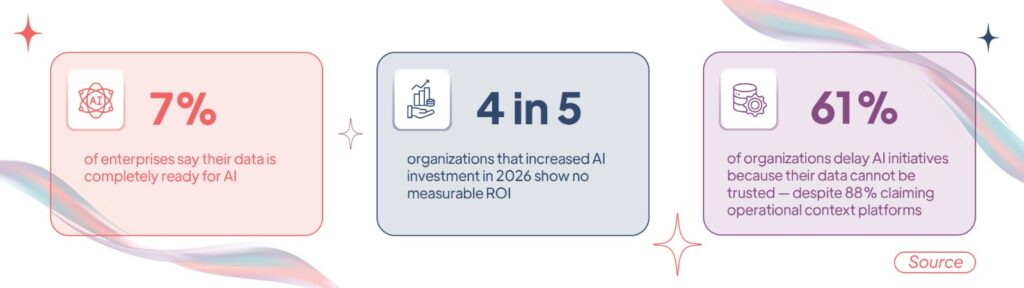
These are not model problems. They are architecture problems.
Semantic context has been one of the most discussed and least solved problems in enterprise data architecture for the better part of a decade. Analyst firms, engineering teams, and AI researchers keep arriving at the same conclusion: the model is rarely the bottleneck. The meaning layer is.
Onix has worked inside this problem across industries, building data platforms, running migrations, and deploying AI agents on real enterprise infrastructure. That experience is what we put into our whitepaper, The Context Gap: Why Enterprise AI Stalls Before It Scales. It maps the architecture of the problem, explains what a Semantic Twin actually does that a data catalog or semantic layer cannot, and gives technical leaders a framework for closing the gap without another rip-and-replace program. To understand what closing the semantic gap actually requires, keep reading.
What a semantic layer solves and what it does not
A semantic layer for enterprise AI translates physical schema into governed business terms: calculation logic, join paths, and aggregation rules. It removes the inconsistency that happens when twelve teams each query the same raw table and get twelve slightly different answers. For BI, this is transformative. For AI agents, it is necessary but not sufficient.
Research across 522 enterprise queries found that agents with unified, multi-dimensional context achieved 38% higher accuracy than agents using semantic definitions alone. The gap is architectural, not a model limitation.
A semantic layer answers ‘what does this metric mean.’ It does not answer ‘what is this entity, how does it relate to others across different systems, what was decided about it last quarter, and who is authorized to act on it.’ Those require something else.
What production AI actually requires
Every successful production AI deployment in 2026 shares four components:
- A knowledge graph for entity and relationship mapping with lineage.
- A governed semantic layer for metric definitions and business logic.
- A retrieval layer for unstructured content.
- A governance infrastructure that makes every AI output traceable back to its source data.
The component most architectures still miss is the fifth: persistent shared memory across agents. Ten agents built by ten teams, each with its own partial semantic configuration, produce ten inconsistent views of the same organizational reality. They contradict each other. Every new agent you add multiplies the inconsistency instead of building on what exists.
Gartner predicts that 60% of agentic analytics projects relying solely on the Model Context Protocol will fail by 2028 due to the absence of a consistent semantic layer. MCP solves connectivity. It does not solve governance, entity resolution, or shared memory.
By 2027 organizations prioritizing semantics in AI-ready data will improve the accuracy of their Agentic AI solution by up to 80% and reduce costs by up to 60%. (Gartner D&A Summit, May 2026)
Why a Semantic Twin is architecturally different
A semantic layer is manually configured, platform-scoped, and static until someone updates it. These three properties create three categories of failure at enterprise scale:
- Definitions drift between teams.
- Cross-system entity resolution does not exist.
- Changes propagate only as far as the teams who know to make them.
A Semantic Twin auto-discovers structure from the data itself rather than waiting for documentation. The analogy that holds: the difference between a DNS server that propagates zone updates automatically and a hosts file someone edits by hand. One scales. The other breaks under its own weight.
The Semantic Twin is also shared infrastructure. Every AI system draws from the same governed knowledge graph. Context built by one initiative is reused by the next one. Agent number ten starts with a richer foundation than agent number one, rather than rebuilding it from scratch.
How Wingspan 2.0 closes the gap
As Onix’s Agentic AI platform, Wingspan 2.0 is built around the Semantic Twin as the core infrastructure layer, not a feature added on top.
Here’s what the platform accomplishes:
- Automatically scans the enterprise data estate
- Discovers entity relationships across source systems.
- Builds the knowledge graph without manual ontology mapping.
- Standardizes business vocabulary into a governed layer that every AI system draws from, auto-refreshing as definitions and data change.
- Maintains full lineage from every AI output back to the source record, which is what compliance and regulatory review actually require.
The practical difference: building a comparable capability manually, through separate ontology projects, team-by-team glossary management, and custom integration work, typically takes 12 to 36 months before the foundation is coherent across the enterprise. Wingspan gets to a working pilot in 10 to 14 weeks because it reads structure from what already exists rather than waiting for teams to document it.
The compounding effect is the part worth internalizing. A semantic layer solves today’s inconsistency problem. A Semantic Twin solves it and builds the foundation every future AI initiative draws from. The investment does not depreciate with each new use case. It appreciates.
If this post covers the what and the why, Onix’s whitepaper The Context Gap goes deeper into the how (read the whitepaper): specifically, how the gap between enterprise data and AI-ready context forms, why it persists even in organizations with mature data infrastructure, and what the architecture of a Semantic Twin looks like across different data estates. It is technical without being abstract, and it is worth reading before your next AI initiative scoping conversation, because the questions it raises about context, lineage, and entity resolution are the ones most architecture reviews skip until they become production incidents.
Learn more about Wingspan 2.0 or schedule a demo to see the Semantic Twin running on your own data estate.
Sources
1. Cloudera / HBR Analytic Services, “Taming the Complexity of AI Data Readiness,” March 5, 2026
3. DataHub, “State of Context Management Report 2026,” March 10, 2026
5. Atlan, “What Is a Semantic Layer?” — OSI specification and Gartner MCP failure prediction, 2026