

A modern live-service game in 2026 is like running a real-time digital metropolis. It’s no longer adequate to simply keep the servers up and running. Gaming success now requires maintaining a “free and fair” playing field (without any cheaters), balancing the virtual economy, and delivering personalized engagement to prevent player churn.
In today’s competitive gaming environment, the gaming infrastructure is inextricably linked to marketing and security. Even a small latency spike can trigger a wave of negative sentiments in the player community, while unchecked cheating can damage the retention rate of the most valuable players.
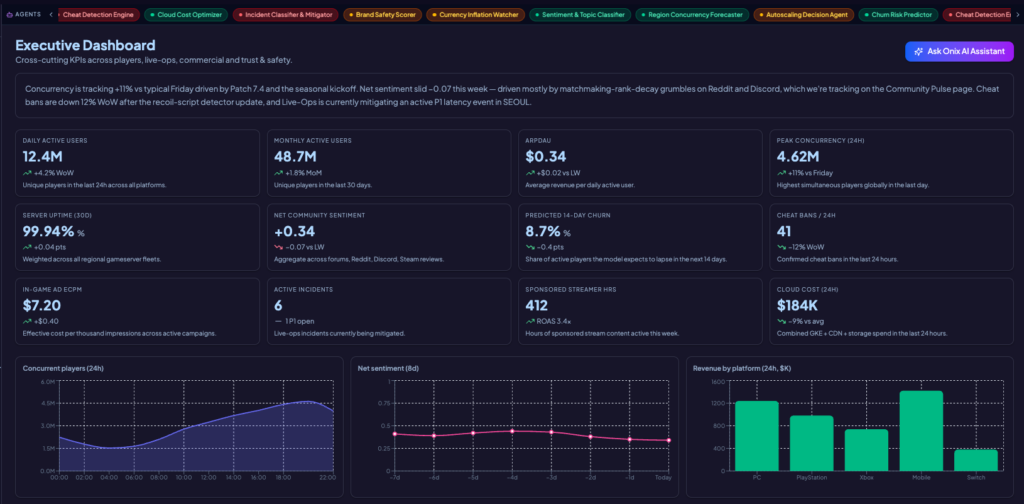
Challenges: siloed data and reactive firefighting
Historically, online game operations have been dominated by rigid data silos. Gaming infrastructure engineers monitored node health on a unified dashboard, while trust and safety monitoring teams were “drowned” in a backlog of manual player reports. Similarly, marketing teams used a separate platform to send generic, broadcast emails.
This level of fragmented data resulted in a reactive approach to firefighting. For instance, by the time an engineer detected and triaged a latency alert, players would already be disconnected. Similarly, a moderator could ban a hacker after reviewing hours of gameplay footage, but not before the damage was already done.
Disconnected systems and human intervention often resulted in burnouts, high operational costs, and high player churn. Here’s our insight on how Agentic AI in gaming can overcome these operational bottlenecks.
Exploring an orchestrated Agentic AI network
Operational bottlenecks in a gaming ecosystem can be overcome by deploying an orchestrated Agentic AI network that oversees the entire system. Instead of using passive dashboards, an Agentic AI platform can deploy a variety of AI agents in gaming, including Insight agents (for anomaly detection) and Action agents (for executing solutions).
Here are 5 critical outcomes enabled by a unified Agentic AI platform:
-
Live-Ops and infrastructure auto-scaling
A unified AI-powered command center can monitor global telemetry across thousands of fleet nodes in real time. Instead of simply alerting human operators, this system can actively self-heal in any unforeseen circumstance. For instance, a “Latency hotspot mapper” can detect a server’s performance lag (for example, loss of a critical packet) and coordinate with the “Autoscaling decision” agent to automatically reroute gaming traffic to other stable regions, while also pre-warming server nodes to mitigate any lag in real time.
Similarly, the “Cloud cost optimizer” agent can simultaneously keep any scaling and routing actions within budget, while maximizing performance.
- Automated trust and safety
Competitive integrity in the gaming domain requires both massive scale and precision. Cheating and hacking can undermine players’ trust and accelerate churn. Even competitive players will exit the game if they detect unfair practices from the gaming community.
The AI-enabled “Cheat detection engine” agent can scan millions of gameplay events and automatically ban for offenses like 97% confidence aimbot signatures. Alongside AI-generated replay annotations, it can also queue borderline cases for human review, thus accelerating the manual review process. - Proactive player retention
In the online gaming domain, a player’s behavioral data is “gold dust,” but only if it’s actionable. Among the best player retention strategies, the “churn risk predictor” can evaluate millions of active player accounts and categorize them according to detailed personas.
This real-time player data is then fed to the “Re-engagement campaign planner,” which can automatically recommend strategies for player retention. For instance, it can recommend sending a “free weekend + double XP” offer to returning players (or lapsers) or a “friend-back invite” to casual co-op players, thus addressing the specific pain points in each cohort. - Community management
In the extremely fickle gaming domain, community sentiment can change in minutes, which is a challenge for human moderators. AI agents in gaming can continuously monitor each player’s pulse using the “Toxicity & Harassment flagger” and the “Sentiment classifier.”
In the event of any issues, the “Empathetic reply drafter” can automatically generate candidate responses to online posts or complaints. Community managers can review, approve, and send these responses, thus ensuring that the community members feel “heard” without involving the customer support team. - Instant studio analytics
In the gaming sector, studio leaders and producers must wait for data-driven decisions from the data science team. The “Producer’s brief composer” and the “Brief-to-viz translator” agents allow them to ask game-related questions in simple English. The agent routes the question, writes the required SQL query, and renders the response as a visual chart on the dashboard, thus providing real-time, actionable insights.
Key benefits & ROI: the power of the tandem agent network
The Agentic AI network tools in the gaming industry don’t work in isolation, but share a business context, overseen by strict governance standards. Here are some of its key benefits:
- Rapid incident resolution
By automating root-cause analysis, along with pre-packaged context and disaster simulation playbooks, gaming studios can leverage AI agents to reduce critical incident mitigation time down to under 7 minutes. - Massive level of scaling
A single orchestrated network can manage up to 97% auto-scale success rates, while sweeping 47 million trust and safety events, and prescribing personalized marketing interventions simultaneously for over 2 million players. - Strategic reallocation of human capital
As AI agents are now handling routine tasks like game server management and scaling, cheating bans, and baseline data clustering, human engineers, moderators, and game producers are free to focus on complex narrative expansion, borderline moderation appeals, and strategic tasks.
Conclusion
At Onix, we realize the importance of delivering customized solutions to meet the challenges of specific industries like gaming. Powered by Agentic AI technology, Onix’s Canopy platform delivers business value through intelligent agents and AI automation.
Contact us today to explore our gaming solutions.
Frequently Asked Questions
- What is an Agentic AI network in game operations?
An Agentic AI network is an interconnected ecosystem of artificial intelligence models that autonomously monitor game data (Insight Agents) and execute specific operational tasks (Action Agents), such as scaling servers, banning cheaters, or launching marketing campaigns, all while sharing context across departments. - How does AI improve video game cheat detection?
AI improves cheat detection by autonomously analyzing millions of backend gameplay events and comparing suspect metrics against peer averages in real-time. It can automatically ban high-confidence cheaters and use computer vision to tag specific moments of hacking in gameplay replays for faster human review, drastically reducing false-positive rates. - How do player personas reduce game churn?
Predictive AI analyzes player behavior to segment audiences into highly specific personas (e.g., “Hardcore PvP,” “Casual Co-op,” “Whales”). By understanding the unique friction points of each group, studios can automatically deploy hyper-personalized retention campaigns—such as free XP weekends or targeted cosmetic drops—that directly address why that specific persona is likely to quit.