

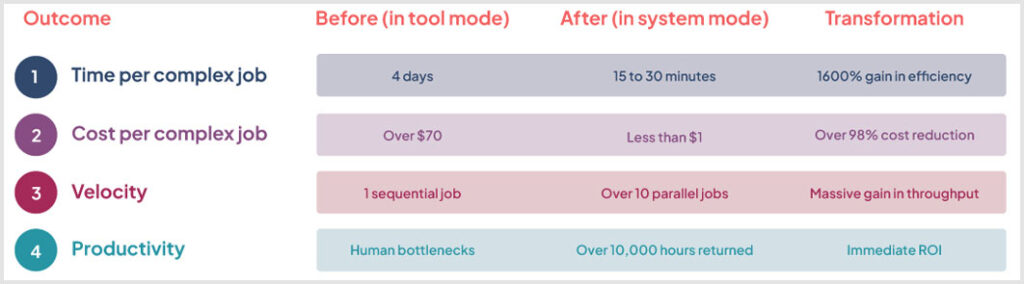
How about completing a complex, critical business process that costs around $70 and 4 days of development time, in under $1 and 15 minutes? This is no longer a theoretical possibility, but a tangible outcome.
A major enterprise undertaking a complex, high-volume data migration project achieved this result. In just 2 weeks of production, this process saved over 10,000 business hours and millions of dollars in operational costs.
What was its “secret” success mantra? The secret wasn’t another enhanced large language model (LLM) or a “clever” AI prompt. It was a complete architectural shift from using AI as a “tool” to a self-improving, autonomous “system.”
In 2026, the time for AI experimentation is over for enterprises looking to achieve transformational value and scale beyond pilot projects. The era of architecting an AI-powered autonomous system is here.
The optimization trap & why enterprises are stuck in the “tool” mode
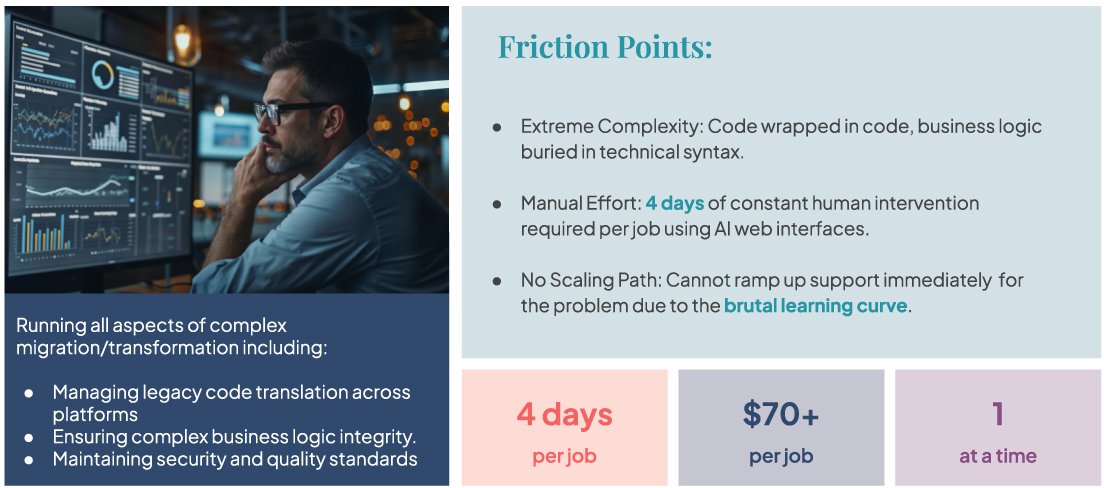
Like most migration projects, this enterprise initiated its project – involving thousands of legacy code translations – by deploying AI as an assistive tool. Here’s what they achieved:
| Approach | Required time per job | Cost per job | Status |
|---|---|---|---|
| Initial copy-paste | 4 days | Minimal cost | Required constant human intervention |
| AI coding assistants | 2 to 3 days | $20 to $70 | Manual, sequential process |
| Prompt engineering & optimization | 1 day | Around $10 | Incremental gains, without any change to fundamental constraints |
In the optimization trap, enterprises end up spending months improving the wrong approach. At around 1 day per job, the entire process of completing thousands of jobs can be both time-consuming and expensive. As a core constraint, this approach requires humans to write prompts and validate each step. Effectively, this operating model is AI-assisted, but human-driven.
The solution to this challenge was to build a self-improving, autonomous AI system, driven by synthesizing cutting-edge AI disciplines like context engineering, multi-agent orchestration, and continuous evolution.
The blueprint: 5 pillars of an autonomous AI system
The first breakthrough was the realization that a complex, sophisticated AI system could not be manually built in 2 weeks. Instead, our approach was to use AI technology to build other systems, which led to the development of the 5 pillars of an autonomous AI system.
To reduce the gap between experimental tools and production-ready systems, enterprises need a robust AI architecture framework, which can save both operational costs and work hours.
The Five Pillars
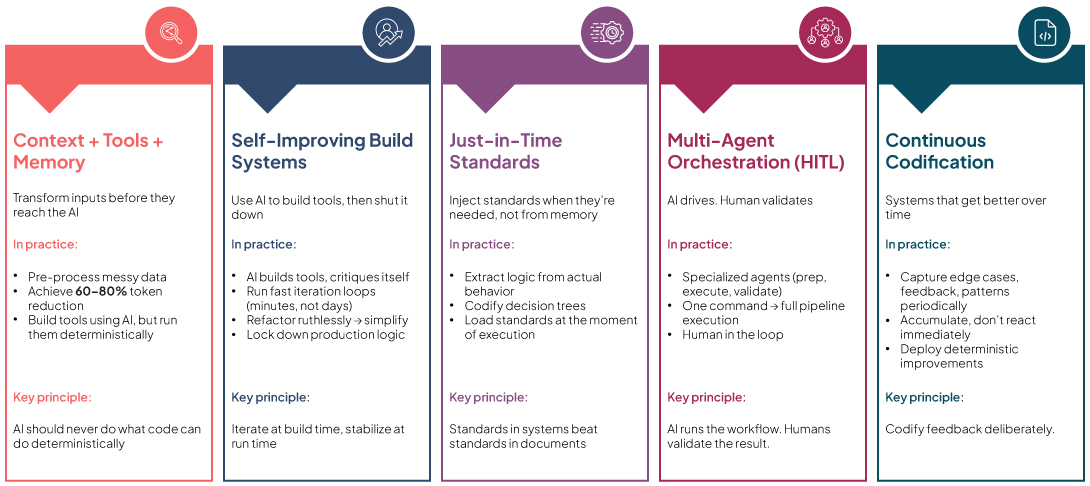
Here are the 5 pillars of an autonomous AI system:
Context engineering + tools
The shift: Instead of feeding raw, unstructured data directly to the LLM, the autonomous AI system transforms the inputs before feeding them to the LLM.
How this works: The AI system uses deterministic code to pre-process the data, thus effectively removing any “noise” and converting complex structures, like legacy code and nested XML, into LLM-optimized formats (like clean JSON).
Why this matters: On average, raw data consumes 60 to 80% more tokens than required, thus increasing costs and AI hallucinations. This approach ensures that the AI system only processes required data, thus reducing hallucinations. It also enforces the golden adage that “AI must not do what can be done deterministically using code.” It also sets up data to “build the tool that can build more tools.”
Self-improving build systems
The shift: From manual prompt engineering, this AI system moves to automated build systems that leverage AI technology to build the required tools.
How this works: Instead of relying on an AI agent to develop the right code during runtime, this system uses AI to create rigorous, compliant tools during the build phase. This allows faster iterations and logic critiques.
Why this matters: A self-improving build system delivers stability. By relying on AI to generate real-time logic, enterprises can ensure both variance and risk management. Additionally, with build-time iterations and runtime stabilizing, AI production environments are run on predictable and tested logic, and not on probabilistic guesses.
Just-in-time standards
The shift: Instead of hoping that AI tools “remember” industry standards (for instance, a 500-page compliance PDF), enterprises can inject the specific standard exactly at execution time.
How this works: The autonomous AI system automatically extracts “tribal knowledge” and compliance requirements from developers’ logs and documentation and categorizes them into distinct standards. The system then dynamically loads the relevant standard for a specific task during execution.
Why this matters: This approach delivers both compliance and scalability. With finite context windows, model performance degrades when stuffed with every compliance rule in the prompt. The just-in-time approach ensures that the AI model has only relevant governance constraints to perform its function, without being overloaded with irrelevant data.
Multi-agent orchestration
The shift: The autonomous AI system shifts from a “human-driven, AI-assisted” model to an “AI-driven, human-validated” model.
How this works: This AI system deploys specialized agents, each to prepare data, execute the work, and validate the output, coordinated by a central orchestrator. The human resource at the end validates the outcome instead of micromanaging the entire process.
Why this matters: This AI system delivers higher throughput. While AI tools allow humans to perform one job at a time, the AI system orchestrator can execute 5+ complex jobs in parallel. This enables enterprises to scale their velocity without increasing headcount.
Continuous codification
The shift: Through continuous codification, this AI system manages edge cases as self-learning opportunities, instead of as errors.
How this works: When this AI system encounters any human correction or fix, it doesn’t just fix the issue for a single instance. It captures the human feedback, analyzes the pattern, and codifies a deterministic rule to avoid repetition of the error.
Why this matters: This is crucial for delivering long-term value. While most AI models degrade over time due to prompt drifts, continuous codification ensures that AI systems improve in value and get smarter, faster, and more autonomous with every successful job.
The transformation from an AI tool to an autonomous system
By implementing these 5 pillars, enterprises can benefit from measurable economic value. Here’s how an AI-enabled autonomous system can change the economics of any business function in under 2 weeks:
Conclusion
As the era of AI tools comes to an end, enterprises that regard AI technology as a holistic, self-improving system will have a competitive advantage. With these 5 pillars of transformation, companies can move from “using” AI to “running” on AI, and build their autonomous enterprise.
With its domain expertise in AI and ML solutions, Onix can help you develop a competitive edge in your industry. Our proprietary AI agent platform, Wingspan, can accelerate data modernization and AI adoption in your enterprise.
Are you looking for a reliable partner to build a self-improving AI system? Contact us.