

In the previous blogs of this series, we discussed the importance of synthetic data for continuous testing in modern development environments. Synthetic data generation tools are emerging as a vital “cog” in application development. That said, every synthetic data generator is not the same.
Typically, rule-based synthetic data generators fail to scale exponentially as the number of rules increases in any dataset. Similarly, other tools generate extremely perfect data, which lacks the realism (or chaos) of real-world data. With rule-based tools, tested applications perform optimally within development environments, but fail when exposed to real-world conditions. Further, manual configuration of these tools cannot keep pace with fast-evolving CI/CD pipelines.
Effective continuous testing (CT) requires intelligent data and not rule-based scripts. Here’s a look at what modern CT frameworks must expect from synthetic data generation.
What continuous testing frameworks actually require from data tools
For any CT framework, data generation is a core and integral part of the entire infrastructure. Modern CI/CD pipelines focus on the “what” of data generation, as well as on “how” data is refreshed and delivered.
Here’s what CT frameworks expect from data generation tools:
- On-demand data generation
As continuous testing occurs around the clock, data must also be accessible on demand for CT frameworks. This is not feasible through manual human intervention. Through automatic data provisioning, CT frameworks can trigger on-demand data without any human involvement. - Production-level statistical accuracy
Valid or updated data is no longer adequate for modern CT frameworks. For continuous quality, these frameworks demand production-level statistical accuracy or synthetic data that can match the distribution and correlation of real-world data. Without advanced data fidelity, CI/CD pipelines can pass application tests, but can fail once the application enters the production phase. - Schema and code awareness
Modern CT frameworks also demand data generation tools with context-aware data infrastructure. Massive data generation is no longer a “bottleneck,” but rather about ensuring that the generated data is in sync with the application code and database structure. This makes schema and code awareness essential for synthetic data generation. - CI/CD integration
For CT frameworks, data readiness is equally important as application testing. The CI/CD infrastructure can automate code integration and configuration, but continues to depend on manual data feeds and snapshots. This can create a major bottleneck that can hamper the pace of continuous testing. With CI/CD integration with data generation, CT frameworks can accelerate testing with an autonomous pipeline. - Built-in governance and security
Testing environments are less secure than production environments, without an optimum level of security, firewalls, and intrusion detection. As a result, CT frameworks require robust data governance and security, not just as a compliance requirement, but to avoid security lapses. By integrating synthetic data generation into CI/CD pipelines, a secure synthetic data platform can deliver effective governance.
In continuous testing frameworks, expectations around governance, security, and reliability are non-negotiable. Onix’s Kingfisher is built to meet these expectations by design, making it inherently suited for CI/CD-driven testing environments.
What makes Onix’s Kingfisher suitable for modern CT frameworks
As an enterprise-grade synthetic data generator, Onix’s Kingfisher is designed to deliver realistic and statistically accurate synthetic data for continuous testing and model training. By integrating directly into CI/CD pipelines, Kingfisher can generate on-demand synthetic data, thus enabling automated testing without any human intervention.
Here’s what aligns Kingfisher with continuous testing frameworks:
- Generates synthetic data from data.
As a synthetic data generator, Kingfisher can generate data from existing data, including file-based data, tabular data, and time-series data. It can easily replicate production-level data with its statistical properties – without including any sensitive information. - Generates synthetic data from code.
Kingfisher can also generate synthetic data from DDL, DML, and application code with matching business logic. Effectively, it can generate data from business use cases, including application code, database schema, scripts, data lineage, and stored logs. - Facilitates a zero-coding platform.
As an intuitive zero-coding platform, Kingfisher enables business and technical users to create synthetic datasets through a guided interface. With its business-friendly “data-as-a-service” layer, Kingfisher allows non-technical users to provision data without any IT bottlenecks. - Scales from a few database rows to millions.
Depending on the testing requirement, Kingfisher can generate synthetic data ranging from a few kilobytes to petabytes, thus enabling scalability in any non-production environment. - Works across industry domains.
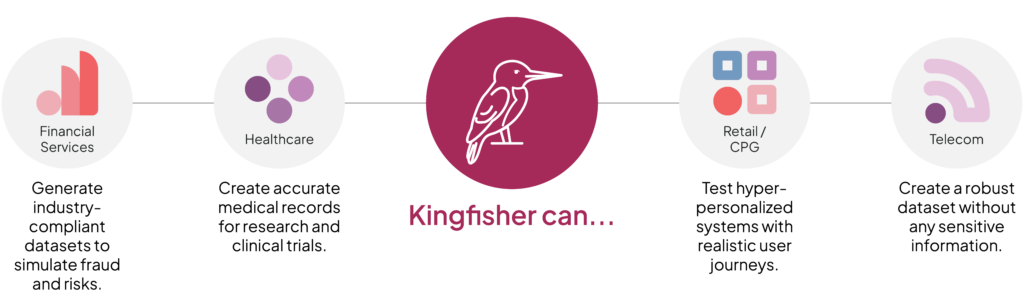
As an AI-powered tool, Kingfisher is “industry agnostic,” meaning it can be used across industry sectors. Some of its common applications are in sectors like healthcare, financial services, retail, and telecom.
Next, let’s talk about how Kingfisher can address data-related challenges across enterprises.
Addressing real-world data-related challenges
In 2026, enterprises are facing a variety of data-related challenges, such as complex governance and the rising cost of data breaches. Gartner estimates that enterprises are incurring annual losses of $15 million because of poor data quality. 62% of leaders regard inadequate data governance as the main hindrance to implementing AI initiatives.
Besides governance, enterprises are hindered by the rising costs of data breaches. The average cost of a data breach in 2026 is estimated to be $4.44 million. As more enterprises implement AI initiatives, there are rising concerns about the quality of their internal data. 90% of AI project failures are caused by poor data quality.
Here’s how Kingfisher can address data-related challenges in enterprises:
- Zero-waiting for data
With AI-enabled synthetic data generation, Kingfisher can create datasets that are statistically similar to production-level data. It can also scale the data volume in these datasets to petabytes without any delay or higher costs. A global bank saved around 85% of time in data preparation by using Kingfisher. - Zero risk to data privacy
By generating synthetic data from application code, Kingfisher can address growing concerns about data privacy and regulatory compliance. This tool also includes complex scenarios and rare edge cases to deliver high-quality data. - Data realism
Kingfisher can address challenges like a lack of data realism by adopting a logic-aware data generation model, instead of simple randomization. It ensures that the generated data adheres to the business logic required by any application. - Secure testing
Kingfisher can mitigate security risks by replacing sensitive information with synthetic counterparts in the testing environment. This effectively reduces the attack surface of the enterprise data.
As an integral part of Onix’s Wingspan platform, Kingfisher embeds synthetic data generation directly into continuous testing frameworks and CI/CD pipelines. This accelerates the AI readiness quotient, enabling 2–3× faster completion of AI initiatives without compromising governance or security.
While challenges may vary by industry, Kingfisher remains industry-agnostic, delivering consistent synthetic data capabilities wherever data is needed. Here’s how Kingfisher can provide unrestricted data across industry sectors:
Conclusion
Beyond the domain of application testing, synthetic data solutions are emerging as a strategic business tool that can be deployed for AI initiatives, business innovation, and privacy-related risk management. As the pace of application development keeps increasing, continuous testing frameworks are a viable solution for fast application releases.
As an AI-generated synthetic data platform, Onix’s Kingfisher supports continuous testing by enabling on-demand data provisioning. Get in touch to learn more about its capabilities.