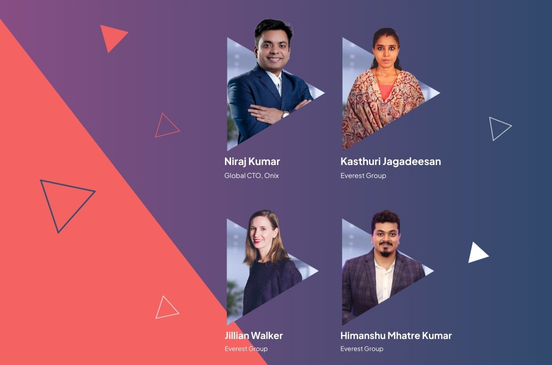
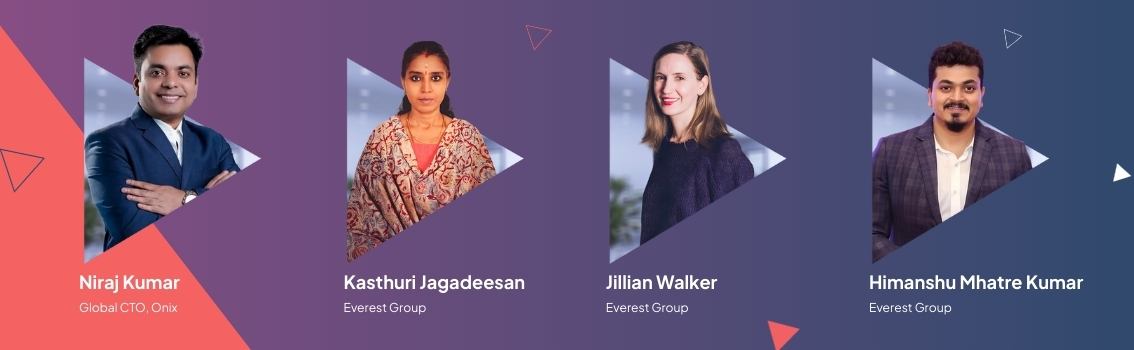
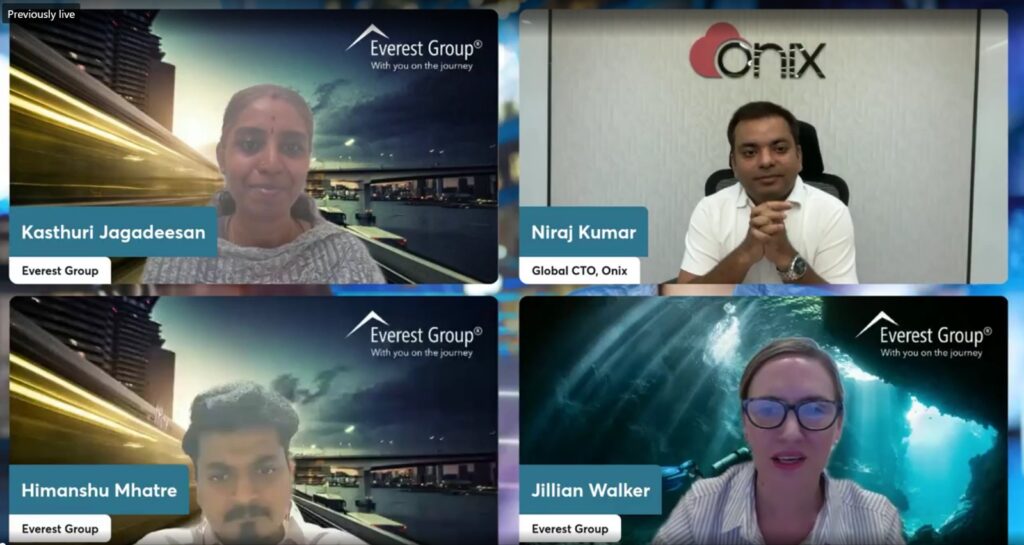
In a recent LinkedIn Live session hosted by Everest Group in collaboration with Onix, Niraj Kumar, CTO, Onix sat down with Jillian Walker, VP, Kasthuri Jagadeesan, Research Director and Himanshu Mhatre, Senior analyst at Everest Group to unpack a shift many enterprises are beginning to acknowledge quietly: AI is no longer confined to chatbots or single-task automation. It is starting to plan, coordinate, and act across systems in ways that resemble collaborative work rather than simple instruction-following.This steady move towards agent-driven systems, AI capable of completing multi-step tasks with limited supervision, shaped the conversation. Across the hour, the speakers explored what agentic AI looks like inside real organizations, where the early value is emerging, and what companies must get right to scale it responsibly. For those who’d like to dive deeper into the full discussion, you can watch the complete webinar here.
A Shift in Enterprise Expectations and How Agentic AI Fits In
Enterprise expectations around AI are changing rapidly. Jillian Walker, VP Everest opened the discussion, pointing out that organizations increasingly want systems that interpret intent rather than just respond to commands. This reflects a practical need: most enterprise tasks are not linear. They require context, decision-making, and coordination across multiple tools.
This is where agentic AI moves beyond the limits of traditional automation. While past systems depended heavily on scripted workflows, today’s agents understand objectives and organize the steps to achieve them. Niraj Kumar captured this change, explaining that real enterprise problems involve choices and branching logic that cannot be predetermined. Agents, he said, “adapt and decide as they go,” which allows them to handle complexity without constant human intervention.
The discussion made clear that this shift is less about futuristic capabilities and more about operational fit. Enterprises want systems that reduce manual coordination, close small gaps in day-to-day processes, and improve the speed with which teams move from information to action. For Everest Group, this change reflects a broader pattern: efficiency is no longer the only driver, adaptability matters just as much.
Where Agentic AI Shows Its First Real Impact and Why Domain Models Matter
The first visible gains from agentic AI are showing up in well-scoped, high-volume workflows. IT operations stood out as the strongest example. Organizations are deploying agents to identify incidents, analyze logs, apply fixes, and close tickets. These processes, once split across multiple tools and team members, now run end-to-end in controlled environments.
Kasthuri Jagadeesan shared examples of businesses where issues are detected and resolved autonomously, reducing delays and freeing teams for higher-value judgement work. Marketing, compliance, and logistics functions are adopting similar patterns, particularly where quick adjustments are needed and repetitive decision-making often creates bottlenecks. For Onix, these early deployments show how practical autonomy can remove friction from everyday tasks.
Supporting this shift is a growing preference for domain-specific AI models. Niraj Kumar noted that such models perform more reliably in enterprise settings because they understand organizational vocabulary and rules. Large general models may be powerful, but they introduce variability that many businesses cannot risk. Everest Group’s observations reinforced this: organizations are choosing models that behave consistently and integrate cleanly into their existing architectures.
Human–Agent Collaboration and How Success Is Measured
A recurring theme was how humans and agents share responsibility. Instead of replacing roles, agentic systems absorb the repetitive, multi-step execution work, allowing employees to concentrate on context, nuance, and decision-making. Niraj Kumar described it simply: “Humans set the goal. Agents manage the execution.” This distinction defines the new collaboration model in enterprises.
Jillian Walker added that organizations are moving from “using AI” to “working alongside it.” That shift in relationship, from tool to teammate, is what enables adoption. People trust systems more when they understand the boundaries of their autonomy and when oversight is built into the process. For readers who want to explore the full conversation, here is the link to the webinar recording for deeper insights: Watch the full webinar.
Measuring success requires new metrics. Traditional automation focused on cost and throughput; agentic systems require indicators that reflect shared work. Niraj Kumar referenced the human–AI synergy index, which captures improvements in insights, error reduction, and workload distribution. These metrics reflect the broader value of agentic workflows: not just efficiency, but smoother operations and quicker decision cycles.
Governance, Readiness, and How Enterprises Should Begin
All speakers emphasised that governance must precede deployment, not follow it. Agents interact across datasets, tools, and applications, creating a need for robust oversight. Niraj Kumar stressed that “you can’t add governance later,” underscoring the risk of retrofitting controls once autonomy has already scaled.
Teams need visibility into how agents make decisions, who can trigger them, and how actions are logged. Memory systems, which allow agents to retain context, add to the importance of transparency. Kasthuri Jagadeesan noted that as memory expands, governance must evolve alongside it. Himanshu Mhatre added that trust is built when employees understand not just what an agent does, but how it behaves.The recommended starting point is modest and measurable. Niraj Kumar advised organizations to “start small, measure impact, build trust, then scale.” High-volume, rules-based workflows provide the most reliable testing ground and offer teams a clear view of where autonomy helps and where oversight is needed. If you’d like to understand how these early pilots play out in real enterprise environments, the full webinar recording offers additional examples and context:
In Summary
The Everest Group × Onix webinar highlighted a clear message: agentic AI is not a future concept. It is entering enterprise workflows in careful, structured ways that prioritise reliability over spectacle. The shift is neither abrupt nor disruptive. It is incremental, built on trust, governance, domain-specific capability, and measured gains.
Most importantly, the movement is not about replacing people. It is about removing the friction in daily work so employees can spend more time on judgement, creativity, and solving problems that matter. Enterprises that begin now, with governance in place and well-scoped pilots, will be positioned to benefit as agentic systems become a standard part of digital operations.