image 81
Onix Semantic Twin

Governed context layer for enterprise AI

Your business speaks in KPIs. Now your AI can too.

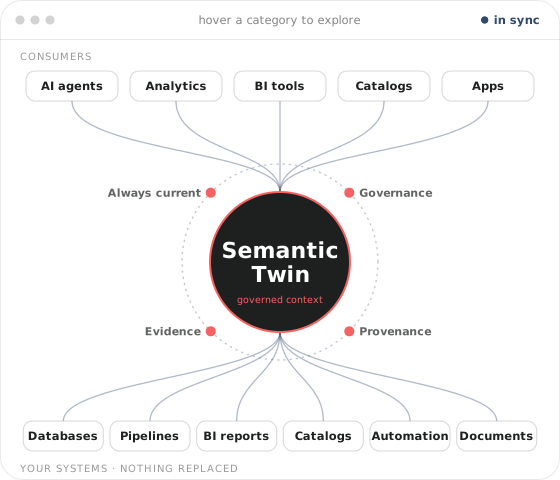
Onix Semantic Twin is a governed context layer that sits between your data and your AI. It gives every agent the data context it needs: what each KPI means, how your data connects, who may see it and where each fact came from. Built from the systems and documents you already run, approved by your owners and kept current, it is AI context your whole business can trust.

up to 95%

answer accuracy with semantic grounding, on certified questions

~70%

fewer tokens per answer through shared context

40+

connectors across databases, pipelines, BI, catalogs and automation

6 weeks

to your first governed domain

The agentic journey

Most enterprises have the cloud and the models. Context is the weak link.

Context is the layer between enterprise data and AI. Cloud gives agents the data and models give them reasoning, but only context tells them what your data means, who may see it and where each fact came from.

01

DONE BY MOST

Cloud foundation

A modern data platform. Data moved, validated and running on BigQuery or its peers.

02

DONE BY MOST

AI foundation

Models, agent runtimes and MCP. Any agent can now reach any table.

03

OFTEN OVERLOOKED

Context foundation

The enterprise context layer
Shared me 192×18 dentity, policy and evidence that every agent reads at query time, kept current.

04

THE GOAL

Agents at scale

Many agents in production, each one cheaper to build than the last, with answers that hold up.

Why an enterprise context layer

Trusted AI answers start with shared business meaning

Onix Semantic Twin gives your AI the data context behind every number. It applies the right definition to every KPI, uses the joins your business already trusts and returns the number your teams agree on, with the source attached.

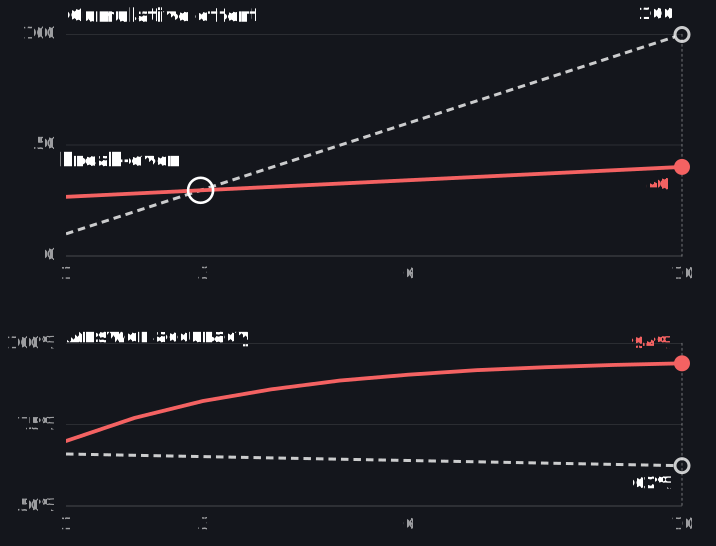
Build meaning once. Each agent costs less and answers better.

Illustrative model of what happens as agents go into production.

Agents in production

0

Effort saved

0 %

Grounded accuracy

0 %
What it does

Governed, traceable and backed by evidence

1 of 3

Governance

Your owners approve every definition, and access rules and policy travel with the context to every agent.

Use case

A support agent answers a billing question without exposing a customer’s personal data, because the policy is part of the context it reads.

2 of 3

Provenance

Every fact traces back to its source system, document and version through column-level lineage.

Use case

An analyst asks where “active member” comes from and gets the table, the query and the Confluence page that defines it.

3 of 3

Evidence

Every answer carries its receipt: the definition, the source passage, the approver and the version it used.

Use case

An auditor challenges a revenue figure and sees exactly which approved definition and which data produced it.

Enterprise
context
always current

How we build it

Reverse-engineered from your estate. Signed off by your owners.

From live pipeline health and SLA monitoring to root-cause diagnostics and autonomous remediation, your data engineers work reliability, lineage and anomalies from one platform.

See how data is actually used today

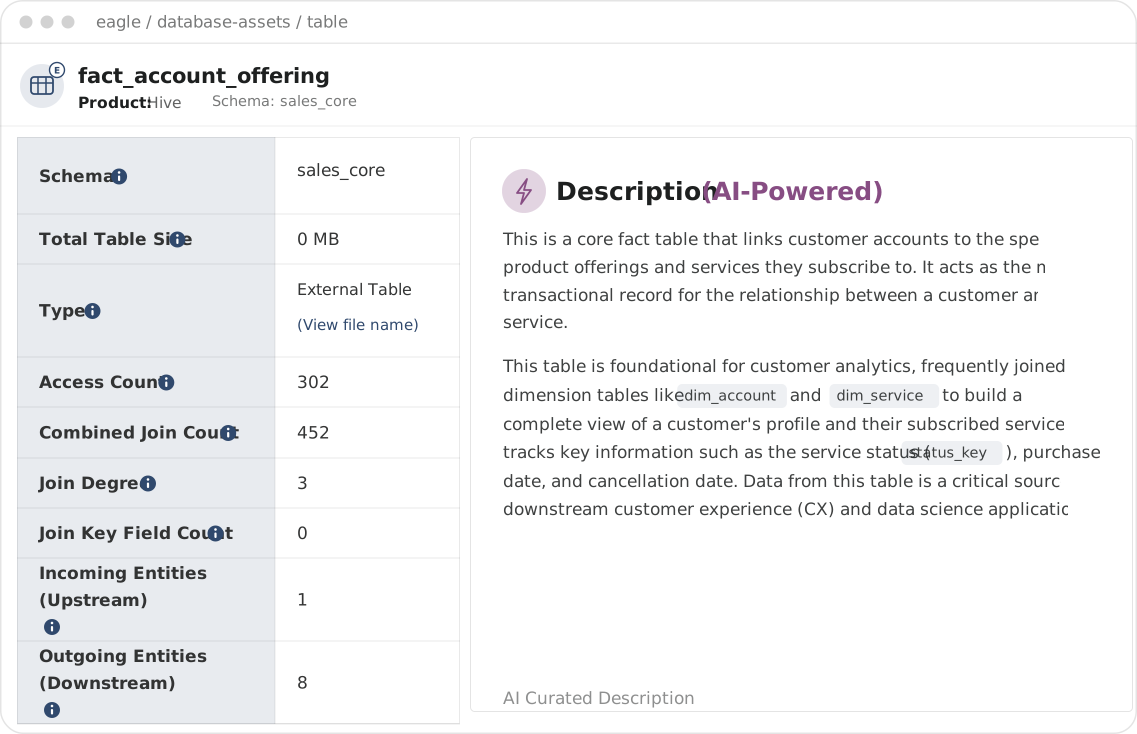
The Enterprise Knowledge Engine, through Eagle, scans query logs, pipelines, code and reports to learn what each asset is, how often it’s joined and what depends on it. It writes a first description for every table without anyone labeling by hand.
  • SQL, ETL, BI and non-Google assets
  • Upstream and downstream lineage
  • Access and join patterns
Semantic Twin technology- Onix

Map your terms and how they relate

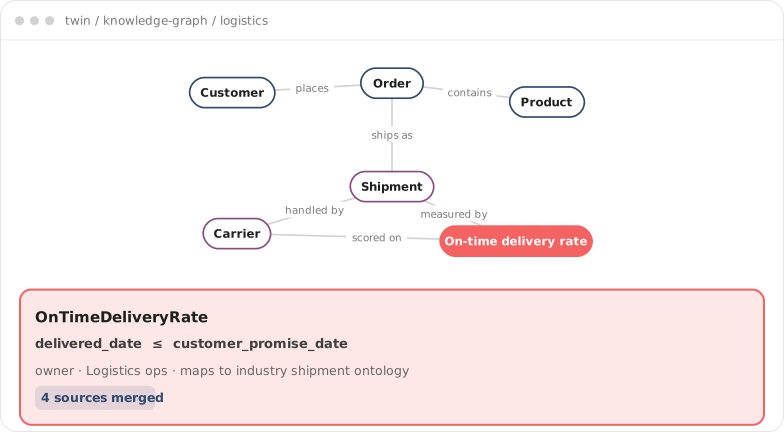
EKE works out what each asset means, finds the same logical asset across copies, filters and renames, and connects your terms into a knowledge graph grounded in the industry-standard ontology you started from.

  • KPIs and relationships discovered, not typed in
  • One identity per asset across every copy
  • Industry and generic ontology mapping

A human owner confirms it before it goes live

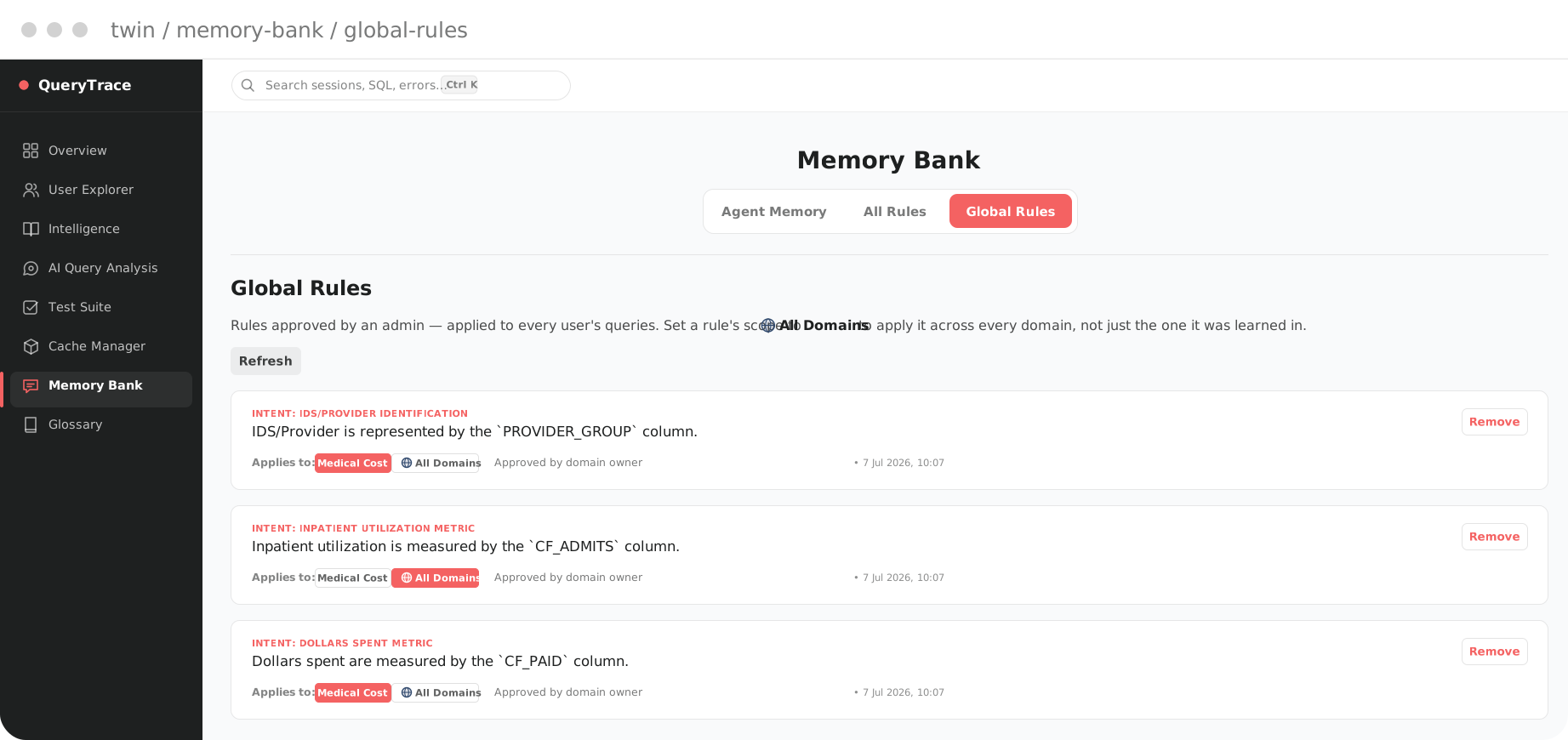
Approved rules apply to every user’s queries, and an owner can widen a rule from one domain to all of them. The approver, date and scope stay with the rule.

  • Proposed, reviewed, approved, published
  • Scope per domain or across all domains
  • You own every artefact we produce
     

One source, served to everything

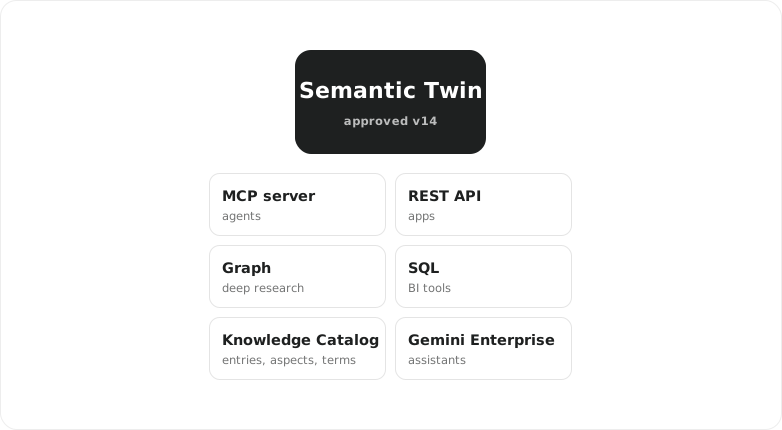
Approved definitions, descriptions and relationships go out through the surfaces your teams already use, and the context harness serves them to any agent runtime at query time. In a Google Cloud estate we write into Knowledge Catalog as entries, aspects, glossary terms and entry links.

  • MCP, A2A, REST API, graph and SQL
  • Knowledge Catalog, Collibra, Dataplex
  • Portable context in open formats: RDF, OWL, Turtle, SHACL

Schemas change weekly. The twin keeps up.

Sentinel agents watch the sources. When a schema moves, a KPI is redefined or a policy changes, the twin re-discovers what changed and routes it back to the owner. Every approved change publishes as a new, immutable version, so grounded agents never read a definition that quietly went stale.

  • Continuous re-discovery
  • Drift routed to the owner
  • Versioned snapshots, queryable as of any date

START

Context assessment

An inventory of your AI use cases, a count of how many times the same assets were contextualised, what that costs to maintain, and a hygiene report on duplicate and stale assets.

PROVE

First domain

One data domain and one hero use case, such as Talk2Data, measured against a baseline agreed in week one.

SCALE

Domain by domain

Adjacent domains reuse the ontology, so each one stands up faster than the last.

SUSTAIN

Kept current

Continuous refresh, drift resolution and a value scorecard your executives see every month.

Architecture

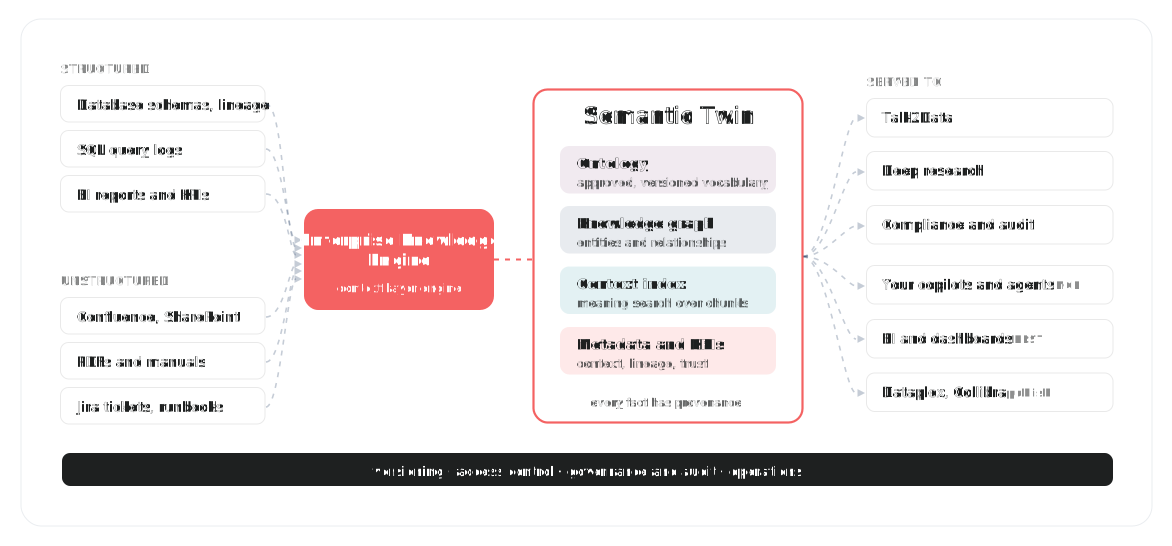
Structured and unstructured knowledge, one governed context layer

image 79 (4)
image 84 (3)

Integrations

Connects to the estate you already run

Semantic Twin page design element- Onix
Apache Airflow

Orchestration and schedulers

Semantic Twin page design element- Onix- IBM
IBM DataStage

ETL and transformation

Semantic Twin page design element- Onix
Amazon Redshift

Databases

Semantic Twin page design element- Onix
Greenplum

Databases

Semantic twin page design element- Onix
Blue Prism

Process automation

Semantic twin page design element- Onix
Collibra

Data catalogs

Semantic twin page design element- Onix
ESPX

Orchestration and schedulers

Semantic twin page design element- Onix
Power BI

BI and reporting

Semantic Twin page design element- Onix
Apache Sqoop

ETL and transformation

Semantic Twin page design element- Onix
Alteryx

ETL and transformation

Semantic Twin page design element- Onix
Netezza

Databases

Semantic Twin page design element- Onix
Databricks

Databases

Semantic Twin page design element- Onix
Unity Catalog

Data catalogs

Semantic Twin page design element- Onix- IBM
Alation

Data catalogs

Semantic Twin page design element- Onix- IBM
Control-M

Orchestration and schedulers

Semantic Twin page design element- Onix- IBM
Talend

ETL and transformation

Semantic twin page design element- Onix
Informatica

ETL and transformation

Semantic twin page design element- Onix
Teradata

Databases

Semantic twin page design element- Onix
IBM Informix

IBM Informix Databases

Semantic twin page design element- Onix
UiPath

Process automation

Semantic twin page design element- Onix
Knowledge Catalog

Data catalogs

Semantic twin page design element- Onix
Apache Oozie

Orchestration and schedulers

Semantic twin page design element- Onix
Hive, Impala and Trino

Databases

Semantic twin page design element- Onix
Snowflake

Databases

Semantic twin page design element- Onix
dbt

ETL and transformation

Semantic twin page design element- Onix
AutoSys

Orchestration and schedulers

Semantic twin page design element- Onix
Snowflake Tasks

Orchestration and schedulers

Semantic twin page design element- Onix
Microsoft Purview

Data catalogs

Semantic twin page design element- Onix
BigQuery

Databases

Semantic twin page design element- Onix
Microsoft SQL Server

Databases

Semantic twin page design element- Onix
Vertica

Databases

Semantic twin page design element- Onix
Matillion

ETL and transformation

Semantic twin- Onix
Tableau

BI and reporting

Semantic twin page design element- Onix
Cron

Orchestration and schedulers

Semantic twin page design element- Onix
Atlan

Data catalogs

Semantic twin page design element- Onix
Automation Anywhere

Process automation

Semantic twin page design element- Onix
IBM Db2

Databases

Semantic twin page design- Onix
Oracle

Databases

Semantic twin page design- Onix
Azure Data Factory

ETL and transformation Orchestration and schedulers

Semantic twin page design- Onix
SSIS

ETL and transformation

Semantic twin page design- Onix
Maestro

Orchestration and schedulers

Semantic twin page design- Onix
DataHub

Data catalogs

Semantic twin page design- Onix
Power Automate

Process automation

Semantic twin- Onix
MicroStrategy

BI and reporting

Any industry

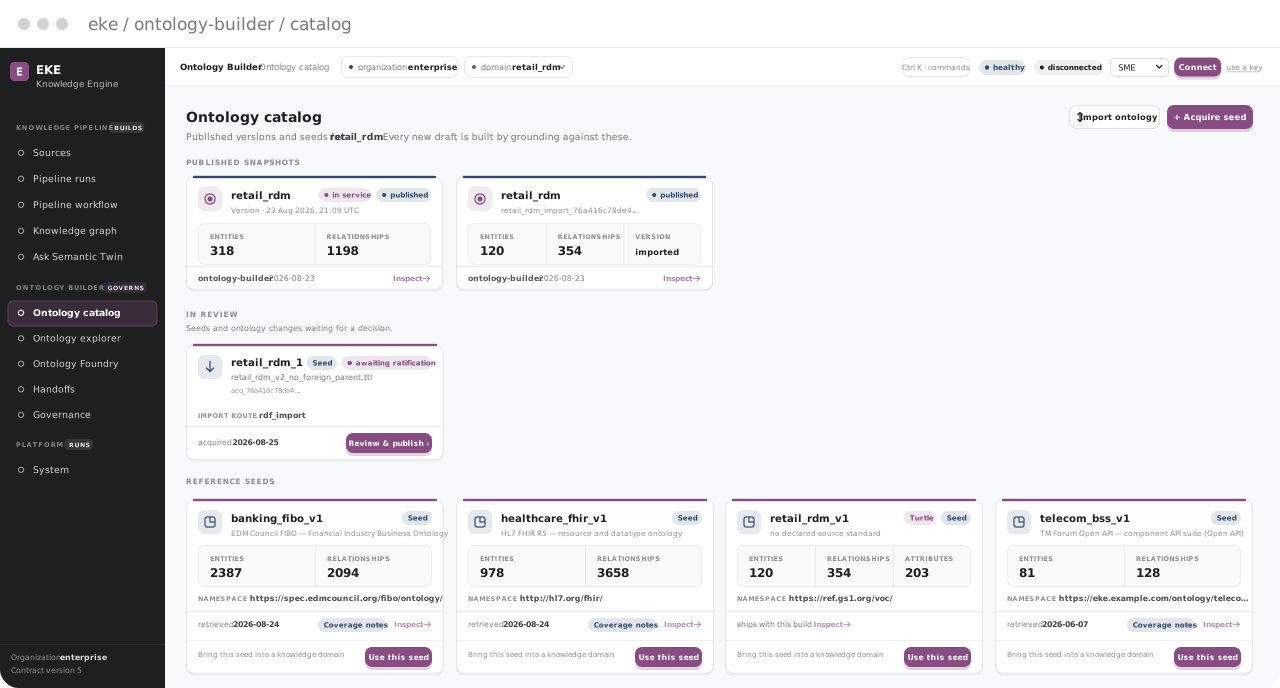
Same engine, any industry. Swap the seed.

image 65 (1)
image 66

The Semantic Twin isn’t built for one sector. EKE starts from the industry standard your business already speaks, then grows it from your own schemas and documents.

SEED ONTOLOGY

FIBO · BIAN

ONE AGREED DEFINITION OF

Net interest margin

"Which customers breach concentration limits across both core banking systems?"

TYPICAL SOURCES

Core banking, loan origination, risk data marts, credit policy documents

AGENTS THAT INHERIT IT

Credit risk, AML investigation, relationship manager copilots

Seed ontology

ACORD

ONE AGREED DEFINITION OF

Loss ratio

"What is our loss ratio by product after reinsurance recoveries?"

Proof point

Talk2Data at a top-5 US health insurer: 90–95% answer accuracy at under $0.04 per request.

TYPICAL SOURCES

Policy admin, claims, reinsurance ledgers, underwriting guidelines

AGENTS THAT INHERIT IT

Claims triage, underwriting assist, regulatory reporting

SEED ONTOLOGY

FHIR

ONE AGREED DEFINITION OF

Medical cost per member per month

"Which provider groups drive inpatient utilization above plan?"

TYPICAL SOURCES

Claims and eligibility, provider directories, clinical policies, benefit documents

AGENTS THAT INHERIT IT

Utilization review, member service, cost-of-care analytics

Proof point

Talk2Data at a top-5 US health insurer: 90–95% answer accuracy at under $0.04 per request.

SEED ONTOLOGY

GS1

ONE AGREED DEFINITION OF

Active member

"How many active members moved up a loyalty tier last quarter?"

TYPICAL SOURCES

POS and e-commerce, loyalty and CRM, supply chain, promotion calendars

AGENTS THAT INHERIT IT

Merchandising analytics, loyalty agents, supply chain copilots

Proof point

A national specialty retailer’s loyalty knowledge connected in one run: 29 documents became 2.2k entities and 231 cited passages.

SEED ONTOLOGY

TM Forum

ONE AGREED DEFINITION OF

Monthly churn rate

"What is churn by plan for customers who called support in the last 30 days?"

TYPICAL SOURCES

Billing, CRM, network assurance, IVR and contact centre systems

AGENTS THAT INHERIT IT

Contact centre Talk2Data, churn prevention, network operations

Proof point

One of the world’s largest telecom providers cut AI initiative setup from 6 months to 6 weeks.

SEED ONTOLOGY

Your own schemas and specs

ONE AGREED DEFINITION OF

Your KPIs, your way

"Whatever your business actually asks every Monday."

TYPICAL SOURCES

Database schemas, OpenAPI specs, catalog exports, business glossaries

AGENTS THAT INHERIT IT

Greenfield bootstrap in a few weeks, then the same governed loop

Why Onix

Built by the team that knows how enterprise data works

Manual, hand-built ontology

Onix Semantic Twin

Customer result

Talk2Data for a top-5 US health insurer

A conversational analytics service grounded in the Semantic Twin, with an observability and traceability layer for audit.

90–95%

answer accuracy

<$0.04

per request

What it returns

Context is an asset. Agents are how you spend it.

Trust

Answers you can act on

Every answer carries its definition, lineage and policy.

Speed

Weeks to trusted answers

Business users self-serve. Analysts analyze instead of reconciling four versions of one KPI.

Scale

The tenth agent costs less

New agents inherit the same governed context. Nobody re-teaches the business.

Economics

Lower cost per outcome

Fewer wrong answers, fewer retries, less human review and fewer tokens spent re-stitching context.

FAQ

What teams ask first

image 80 (5)

Onix Semantic Twin is a governed context layer for enterprise AI. It is a living model of your business, built from your data, code, reports and documents, that tells every agent what your data means, how it connects, who may use it and where each fact came from. Teams building AI agents often call this data context or AI context. The twin builds it once, has your owners approve it and keeps it current, so every agent and BI tool reads the same governed meaning.

A catalog documents assets for people. Onix Semantic Twin grounds agents at query time, across platforms, with policy attached. We integrate with your catalog and write into it rather than replacing it.

For your Google estate, largely yes, and it’s where we publish. We add the business meaning it can’t reach on its own: process and policy definitions, KPI logic your CFO will sign, one identity for an asset across copies, and systems with no connector at all, such as mainframe, bespoke apps and legacy BI.

Reverse ontology works from what exists today. Quality signals become part of the context, so agents know what to trust. Waiting to clean everything first is exactly what stalls these programs.

RAG retrieves documents. The Semantic Twin governs meaning (definitions, identity, lineage and policy) and serves it to any agent, including your RAG applications.

You do. The Enterprise Knowledge Engine proposes and your domain owners approve. Nothing grounds an agent without their sign-off, and every artefact we produce belongs to you.

Sentinel agents detect the change, re-discover what it affects and route it to the owner. The approved version updates, and every grounded agent reads the new definition from then on.

It’s the engine that creates the context layer. It connects to 40+ systems, reads the technical estate through Eagle (SQL, ETL, code, logs, lineage and BI) and reads documents such as wikis, PDFs and tickets. It builds the ontology from an industry seed, keeps a receipt for every fact, and proposes changes for your owners to approve.

Four things make it hard. Definitions drift as teams change their reports. The same asset lives in many copies under different names. Policy and quality sit in separate tools from the data. And much of the meaning lives in documents, not tables. EKE handles each one: it tracks definitions as they change, resolves one identity per asset, attaches policy and quality to the context, and reads documents alongside data.

Yes. The context is yours and it’s portable. Ontologies export in open formats such as RDF, OWL, Turtle and SHACL, and the twin publishes through open standards including MCP, A2A and OpenLineage.

No. The engine is the same in every industry. What changes is the seed ontology it starts from, such as FIBO for banking, ACORD for insurance, FHIR for healthcare, GS1 for retail or TM Forum for telecom. With no standard to start from, it bootstraps from your own schemas, API specs and glossaries.

No. Wingspan is powered by the Onix Semantic Twin, but the Semantic Twin is a product in its own right. Your own agents, copilots and BI tools can read from it through MCP, APIs, graph and SQL, with or without the rest of Wingspan.

image 66

Get started

Start with one domain.
Let every agent after it inherit the work.

A two-week context assessment counts what you're already spending to rebuild the same business context, and names the domain to start with.

Subscribe to to stay in the know

Get our newsletter and latest updates about our company, what we are working on, and other cloud-related news.